

We all want churches, schools, and youth programs to be the safest places for kids.
Most days they are. Sometimes, though, harm can hide in plain sight. Most abuse is relational, not stranger-driven, which means people who cause harm often groom children, families, and even whole communities over time.
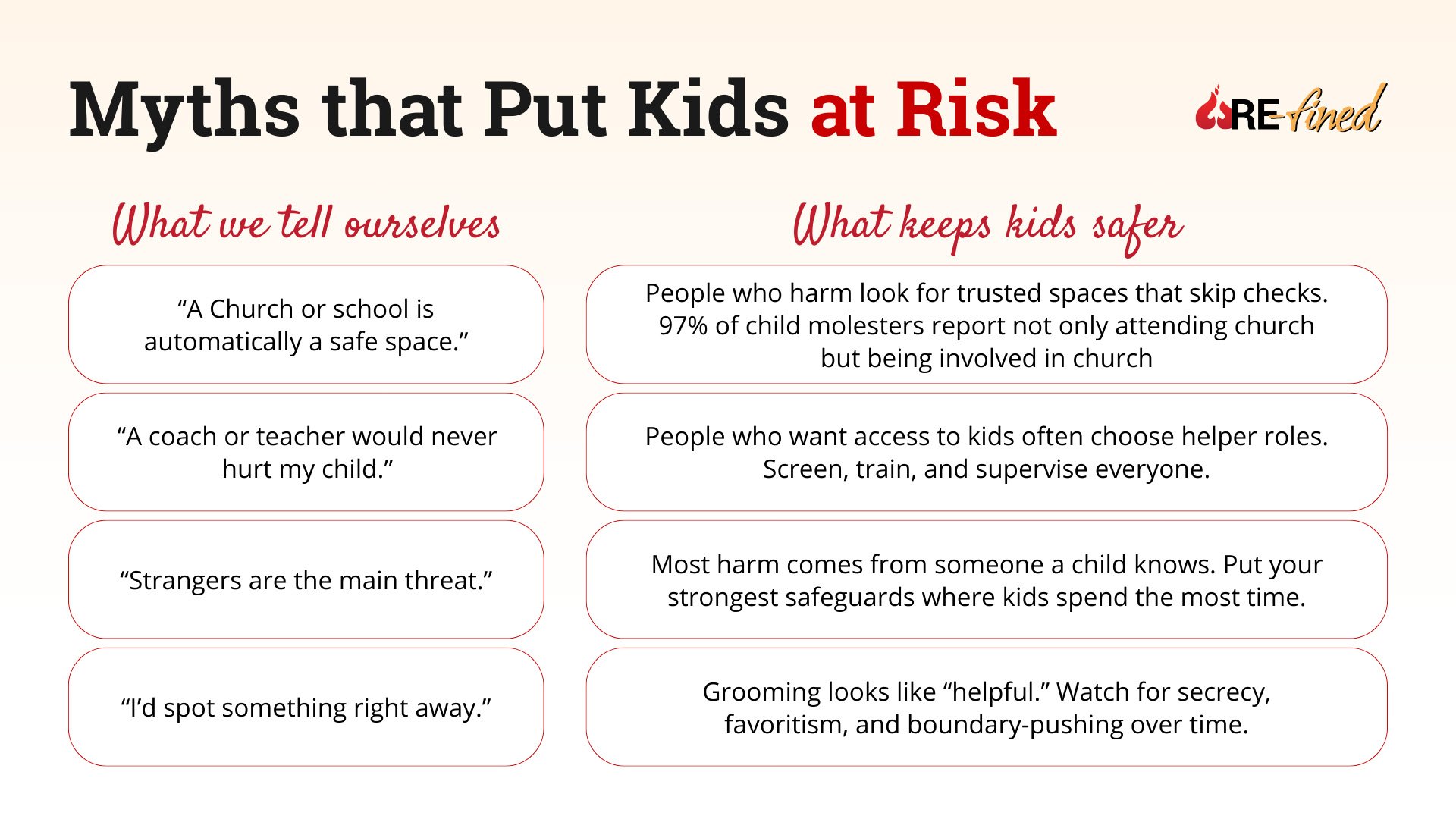
And it isn’t only adults — older youth can hurt younger children, too — so effective child sexual abuse prevention has to address both adult–child and child–child risk.
One thing never changes: abuse is 100% the responsibility of the person who chooses to harm, not the child, not the parent, not the organization.
Still, strong systems make abuse much harder to perpetrate. The steps below will help you turn your church, school, or program into a safer places by putting practical child sexual abuse prevention into everyday practice.
Safety note: if a child is in immediate danger, call emergency services right away.
Step 1: Screen Before Day One
Bringing new people onto your team is exciting. It’s also the first big chance to protect kids. Strong screening isn’t about catching “bad apples.” It’s about setting a clear safety standard from the start so child sexual abuse prevention is built in, not bolted on later.
Start with a real application
Ask for more than a résumé.
- Work and volunteer history with dates
- Relevant experience with kids
- Motivation for applying and what “safe boundaries” means to them
- Two to three non-family references who have seen them work with children or teens
Run Background Checks
Use a consistent process for every role.
- Criminal background check and Sex offender registry check
- Re-check at regular intervals (for example, every 1–2 years)
Call references and ask behavior-based questions
Of course, you’ll have to check a candidate’s references for red flags. During the call, ask the following questions:
- “Would you leave your child with this person? Why or why not?”
- “Have you seen them push or ignore boundaries with kids or coworkers?”
- “Tell me about a time they handled a hard ‘no’ from a child or parent.”
Use interview scenarios, not just “tell me about yourself” (scenarios reveal judgment under pressure).
- “A student DMs you on Instagram at 11:00 PM needing to talk. What do you do?”
- “A teen asks for a ride home alone. Walk me through your response.”
- “You notice another volunteer pulling one child aside repeatedly. How do you handle it?”
Why this matters
Clear screening protects kids, supports healthy leaders, and sets a tone everyone can follow. When people know your standards before day one, you reduce opportunity for grooming and create a culture where safety is normal, expected, and shared.
Step 2: Set Clear, Written Boundaries
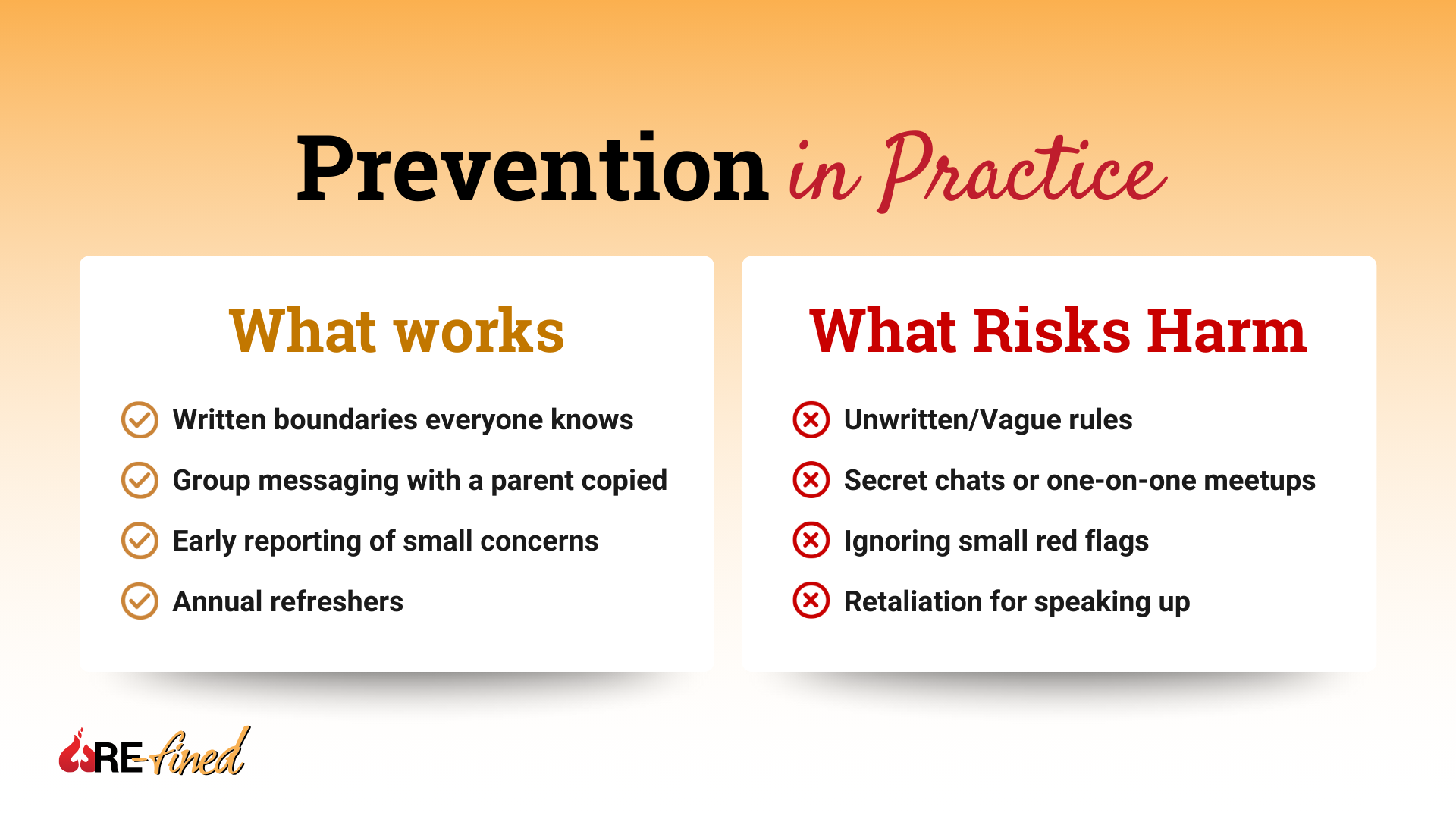
Great policies take the guesswork out of safety. Put your boundaries in writing, teach them to everyone, and use the same standards for staff, volunteers, and older youth.
What Your Staff or Volunteers Can Say to Teens
A volunteer can say the following to a teen:
- “We don’t do secret chats here.”
- “If you need to talk, we’ll include another safe adult.”
- “An adult will always be nearby.”
These are reassuring to a child and establish that safe and surveilled interactions with adults are the norm.
What to Tell Parents and Other Adults
Use clear, consistent language so everyone knows the boundaries:
- “For everyone’s safety, we meet in open spaces.”
- “If one-on-one is needed, another screened adult will be nearby.”
- Guidelines on acceptable gestures (e.g. high-fives and fist bumps are fine; side hugs only, with permission and in public; no full hugs; children over age 3 do not sit in laps.)
- For younger children: bathroom and diapering follow a written policy that families can see. Two-adult visibility when possible, doors ajar or hallway sightlines, quick check-ins by a roaming supervisor, and all help is logged.
- “Photos are only taken with parent consent and never posted to personal accounts.”
- “No secret gifts or private chats. If a child needs to talk, we include another safe adult.”
Enforce these boundaries, and child sexual abuse prevention will be baked into your organization’s culture.
Step 3: Make Supervision Visible
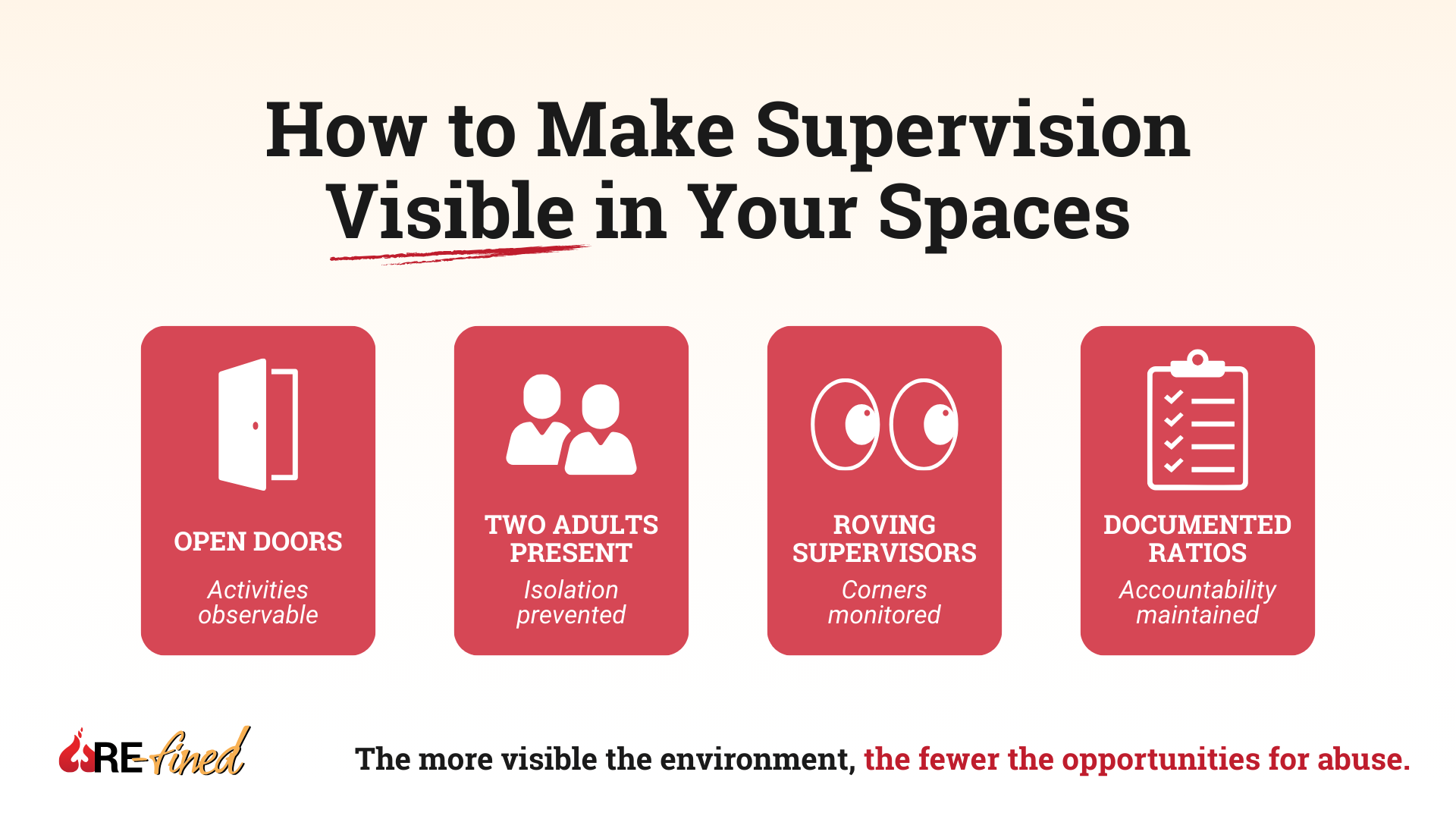
What’s safer — a wide open space where everyone can see what’s going on or areas with nooks and blind corners? Abuse looks for privacy, but you can remove it.
Put visibility on autopilot
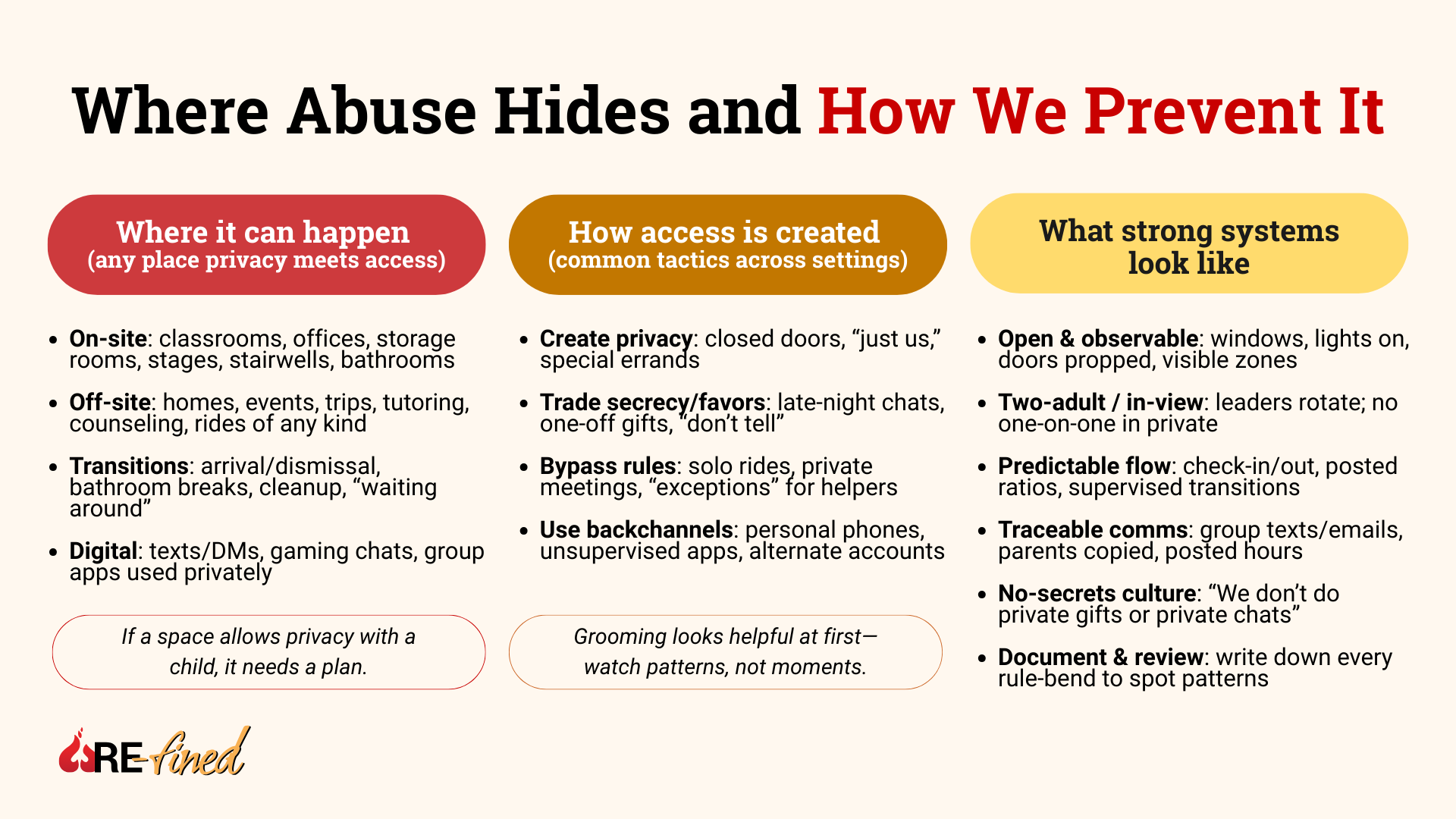
To create safe visible spaces, these are some of the practices we swear by:
- Two-adult presence: No child should ever be left alone with one unsupervised adult or older child/teen.
- Windows in doors and open spaces: These keep activities observable.
- Roving supervisors: Ensure staff are moving through classrooms, hallways, or activity areas without notice.
- Documented ratios: Leaders must be in charge of safe staffing levels.
- Rotations: These prevent pairing staff or volunteers repeatedly with a child.
On-the-spot language
- “Let’s keep this door open so everyone can see and hear.”
- “I’ll be walking through rooms during small groups—wave if you need me.”
- “Switch partners, please. Older youth should pair with another leader, not a younger child.”
Step 4: Keep Communication Traceable
Private DMs are where secrets live. Create simple rules that keep conversations transparent and still caring.
Make it easy to do the right thing
- Approved channels only (church/school email, team app).
- Copy a parent/guardian on messages with minors.
- Shared inboxes for program accounts.
- Posted response hours so kids know when to reach out.
Replies to have ready
- To families: “Our team uses group texts or email with a parent copied. We don’t message minors privately.”
- To a teen who DMs a leader: “I’m glad you reached out. I’m adding [Parent/Safety Lead] so we can support you together.”
Remember: When every message has a paper trail, predators have less leverage, and the young ones in your care are protected.
Step 5: Train Everyone to Spot Grooming Early
Grooming often looks like kindness that bends the rules. Teach your team to notice patterns, speak up early, and document instances in writing as soon as they occur.
Red-flag patterns
With teens or kids who use devices
- Private DMs or texts from a personal account
- Late-night messages or “don’t tell your parents” language
- One-on-one rides or off-site meetups
- Special treatment or gifts, photos on a personal phone
With younger kids or kids without phones
- Taken to closets, storage areas, or stairwells out of view
- Lap sitting over age 3 or touch outside policy
- Secret nicknames or “inside jokes” that exclude others
- Bathroom or diapering without visibility or a second adult
Normalize documenting “small” concerns
Predators test systems. Normalize quick notes, review them regularly, and retrain where needed. Patterns show up fast when your team writes things down.
Use a simple line: Who, what, when, where, which policy.
Example: “Sun 9:45am, Room 204 — Leader sat with 8-year-old behind stacked chairs out of view. ‘In-view supervision’ policy not followed.”
How to say it
- To a peer: “I noticed you and Jordan were often by the storage room. Our policy is ‘in view.’ Let’s move to the main area. I’ll note this on the log.”
- To a supervisor: “I’ve logged three times Sam brought personal gifts to one student. It may be nothing, but it’s a pattern and I want it reviewed.”
What Successful Training Looks Like in Practice
In case you’re wondering what successful training looks like, imagine a Wednesday evening youth program.
In this scenario, one of your volunteers notices another leader taking a 12-year-old to a supply closet.
Seeing this, your volunteer steps into the hall, keeps the door open, and says:
“Let’s set up with the door open and in pairs.”
And when it happens again, that same volunteer logs the details and alerts the safety lead. You then retrain the team later that week, change room use, and check in with the family.
Step 6: Create Reporting Paths People Actually Use
If reporting feels scary, people stay silent. Build simple, safe routes to raise concerns.
Set the basics
- Offer multiple routes: your safety lead, a backup safety leader, and an anonymous form.
- Promise no retaliation for good-faith reports.
- Keep it need-to-know only. Bring concerns straight to designated leaders, not to hallway chats or group texts. Rumors can harm kids and families.
Put the tools in place now
Post a one-page “How to Report” sheet in staff areas with names, roles, and direct contacts. Add a QR code to your anonymous form on that sheet and in volunteer handbooks. Include your state hotline and online reporting link in the handbook and team app so no one has to hunt for it in the moment.
How to say it
- “If something makes you uneasy, report it today, even if you’re not sure.”
- “Please bring this to me or our safety lead so we can protect the child’s privacy.”
- “You won’t get in trouble for raising a concern. Thank you for speaking up.”
Avoid
- Checking around with other volunteers or parents.
- Posting concerns in group chats or social media.
- Confronting the child or the person of concern yourself. Instead, route it to the safety lead.
Mandated reporting
Remind your team who is a mandated reporter in your state and give the exact link and hotline they should use. (Add state-specific details here.)
Step 7: Respond to Disclosures With Care
The most important thing you can do is to listen with care when a child brings up abuse. By responding supportively, you can help ease fear or shame. False reports are rare (often cited around 1%), so start from belief.
What to say
- “Thank you for telling me.”
- “This is not your fault.”
- “You did the right thing by speaking up.”
- “My job is to help keep you safe. I will get the right people to help.”
Then write down the child’s words as accurately as possible and follow your reporting policy promptly.
Remember: Don’t investigate yourself and don’t promise secrecy.
Step 8: Build a Safety-First Culture
Policies are only as strong as the culture around them.
Make safety part of your identity
- Leaders say, and show, that safety comes before attendance or convenience.
- Annual refreshers and quick “policy moments” at team meetings.
- Clear signage about boundaries and reporting paths where parents can see them.
- Celebrate early reporting as a win for kids, not a “problem.”
Leader lines
- “We measure success by safety, not just turnout.”
- “Policies apply to everyone, every time.”
Child Sexual Abuse Prevention Is Possible
Child sexual abuse prevention is an ongoing process that involves screening, setting clear boundaries, and baking in safety as part of your organization or institution’s culture.
Screen well, set clear boundaries, keep supervision visible, make communication traceable, train your team, and respond with care. You can do this, and we can help!
Let’s make your safe place even safer.
- Training: Invite Re-Fined to deliver live, trauma-informed training for your church, school, or program.
- Support: Partner with us financially so we can keep bringing practical prevention to communities across Colorado and beyond.
FAQs
What does child sexual abuse prevention involve?
Clear systems that reduce opportunity for abuse, strengthen oversight, and give kids predictable protection in every setting — screening, boundaries, visible supervision, traceable communication, training, and usable reporting paths.
Do child sexual abuse prevention practices apply only to adults working with children?
No. Older youth can also harm younger kids. Strong policies cover adult–child and peer-peer risk, and teach everyone the same safety habits.
How can organizations start right away?
Write down your boundaries, make communication transparent, keep two adults in view, and train leaders to act on early concerns. Small, consistent steps make spaces safer fast. Also put these in place:
- Run background checks at onboarding and on a set schedule (for example, every 1–2 years).
- Require annual safety training refreshers for all staff and volunteers.
- Make onboarding mandatory for every new volunteer: a sit-down or training to walk through rules, scenarios, and how to report.
